
Majestic Cities of Central and Eastern Europe
< View Other Tours
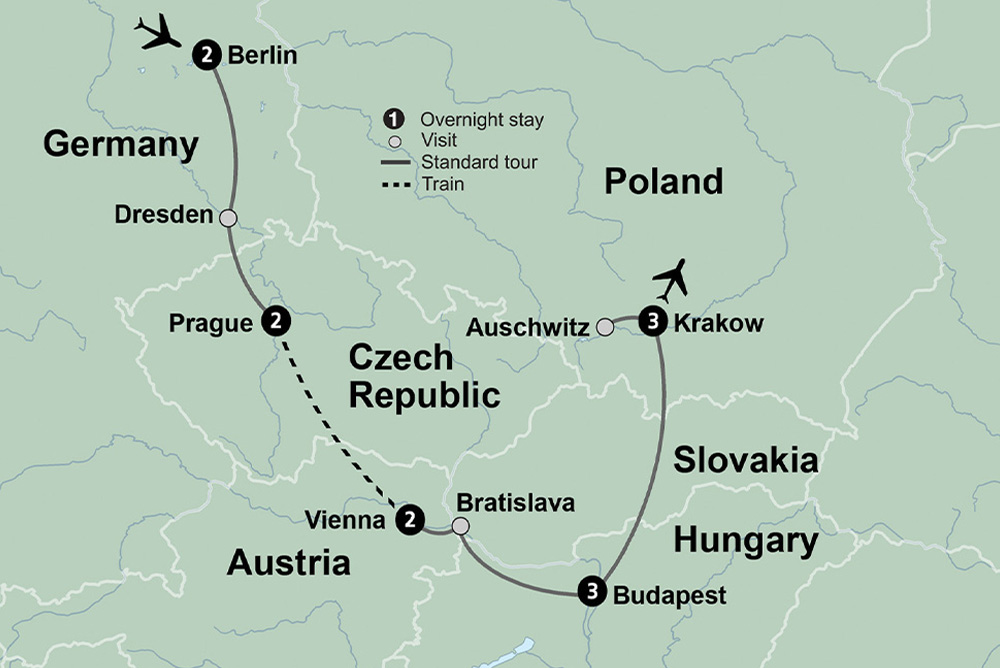
Explore a land where world history and fairy-tale charm come to life in the culturally rich, majestic cities of Central & Eastern Europe.
Trip Code: 14672
Start
Berlin
End
Krakow
Destination
Germany
Meals
In Total 19 Meals
Transport
Bus Available, Flight from Krakow (KRK) to Berlin Brandenburg International Airport (BER)
Days
13
Style
Explorationsi
Activity Level
3i
Why you'll love this trip
- •
Berlin
Berlin is the capital and the largest city in Germany. Berlin is located in northeastern Germany on the banks of the River Spree. Berlin dates back to the 13th century. Throughout history Berlin has played a major role in several wars including World War II and the Cold War. After the Cold War ended, the Berlin wall, which divided East and West Berlin, fell. Part of the wall is still intact and visible today, and serves as a reminder of an important part of Berlin’s history. Today, modern Berlin is known for its many cultural attractions, architecture and its high quality of living.
- •
Dresden
This city is located on the Elbe River in Saxony, not far from the Czech border, and has a population of about one million. It is known as the “Jewel Box” for the baroque and rococo architecture in the city center, created by the Kings of Saxony who were based here. In the 20th century it was most famous as one of the cities that were firebombed by the Allies in 1945 near the end of WWII. In 3 days over 90% of the city center was destroyed by incendiary bombs and the firestorm which followed, and Kurt Vonnegut’s book “Slaughterhouse Five” was based on this raid. Dresden was in East Germany until the reunification in 1989, and the city center has been well restored.
- •
Prague
Prague is the capital of the Czech Republic and of the state of Bohemia, with a population of about 2 million in the metro area. Because it received very little damage in WWII, it is has many beautifully preserved sights from several eras and its historic center is a UNESCO World Heritage site. It was capital of the Holy Roman Empire and a center of the Austro-Hungarian Empire, and it was the site of the Velvet Revolution in 1989 when citizens peacefully took Czechoslovakia back from the Communists. It is known for music (composers Dvorak, Smetana and Mozart lived here), literature (Franz Kafka) and for having almost as many kinds of Pilsner beer as it has bars and restaurants.
- •
Prague Castle
Prague Castle is a complex of intrigue based in 9th century stone – an ancient symbol of the Czech State and one of the world’s most significant cultural landmarks. The largest castle complex in the world and a UNESCO World Heritage Site, the castle serves as the official home of the President of the Czech Republic, and the residence of princes and kings since the 10th century. This age-old, ageless landmark hides a different kind of stone, or stones – Prague Castle is home to the Bohemian Crown Jewels. The crown, the scepter, and the coronation cloak of St. Wenceslas is protected behind a chamber door, an iron safe, and seven locks – the keys to which only seven people possess.
- •
Pannonhalma Archabbey
- •
Vienna
This is the capital city of Austria, located on the Danube, with a population of over 2 million in the metro area. It is known as the “City of Music” because of the numerous famous composers who have lived and worked here, such as Mozart, Haydn, Beethoven and Brahms, and also as the “City of Dreams” as it was home to Sigmund Freud. Some of its primary sights are Schonbrunn Palace, Hofburg Palace, Opera House, Belvedere and St. Stephen’s Cathedral. Vienna is also known for its coffee houses and restaurants.
- •
Viennese Coffee House
- •
Budapest
This city on the Danube is actually two cities: Buda and Pest, divided by the river. In its history, it has been Celtic, Roman, invaded by Mongols and Turks, second capital of the Austro-Hungarian Empire and now the capital Hungary, with about 1.8 million people. Its varied architecture from so many cultures helped make Budapest a UNESCO World Heritage site, and it is known for its coffee houses, traditional Hungarian restaurants and working Turkish baths from the 16th century.
- •
Kraków
A city that has grown from a Stone Age settlement to Poland’s second most important city, Kraków is one of the oldest cities in Poland, dating back to the 7th century. The historic city has traditionally been one of the leading centers of Polish academic, cultural, and artistic life and is one of Poland’s most important economic hubs. The 15th and 16th centuries were known as Poland’s Golden Age, when many works of Polish Renaissance art and architecture were created. In 1978, UNESCO placed Krakow Old Town on the first-ever list of World Heritage Sites. In Kraków, visitors will see notable Renaissance buildings and synagogues, as well as modern buildings featuring new architectural styles.
- •
Wawel Castle
This 14th century Gothic castle is in Krakow, Poland’s 2nd largest city, and was built by Casimir III, and is considered the most important cultural site in Poland. It was the residence of the Kings of Poland, and the sword called Szczerbiec, which was used in the royal coronation ceremonies, is on display in the castle. It is now used as an important art museum, with collections of Italian Renaissance paintings, textiles, tapestries and armor. Before WWII it was the official residence of the Polish President, and since has become a national museum. A fragment of a column from Wawel Castle is incorporated in the Tribune Tower in Chicago as a tribute to the large Polish population of Chicago.
- •
Auschwitz
This town was called Oswiecim by the Poles, and in 1940 the Nazi occupiers of Poland established a camp here to house Polish political prisoners, part of a network of concentration camps which began to appear in the 1930s. It was part of a large network of camps by the end of the war. In 1941, the Nazis began a second camp, Birkenau, nearby to house the ever-increasing number of prisoners. Also in 1941, Auschwitz-Birkenau became the largest of the Nazi death camps, when mass exterminations began using Zyklon B gas. The exact death toll will never be known, but it is estimated to be between 1.5 and 2 million dead, with as many 900,000 Jews in that number. The SS destroyed most records, and the estimates have been put together from many other sources, such as train records. Joseph Mengele conducted numerous medical experiments here, especially on twins and dwarfs. The camp was liberated in January of 1947 by the Red Army.
Itinerary
Inclusions and activities
Meals
In Total 19 Meals
Transport
Bus Available, Flight from Krakow (KRK) to Berlin Brandenburg International Airport (BER)
Included activities
Optional activities
Is this trip right for you?
- •
There are some long travelling days on this trip, but it’s all part of the adventure and a great way to get to know your fellow travellers.
- •
This trip requires a moderate level of fitness as it involves some walking and swimming, allowing you to really get among nature. Please bring sturdy, comfortable walking shoes, a swimsuit and comfortable clothing.
- •
Multiple activities on this trip are subject to weather and water conditions and on occasion, may be cancelled for safety or operational reasons. In the case of cancellation, we will endeavour to find a suitable replacement activity.
Dates and availability
Questions About This Tour?
Our travel experts are here to help you plan the perfect adventure. Get in touch for personalized advice and recommendations.